Food allergens remain one of the most significant food safety challenges for manufacturers, retailers and food service businesses. Effective allergen management protects consumers, supports legal compliance and helps safeguard your brand.
Food Forensics provides expert allergen testing and technical advice to help businesses understand allergen risks, investigate unexpected results and develop appropriate testing strategies.
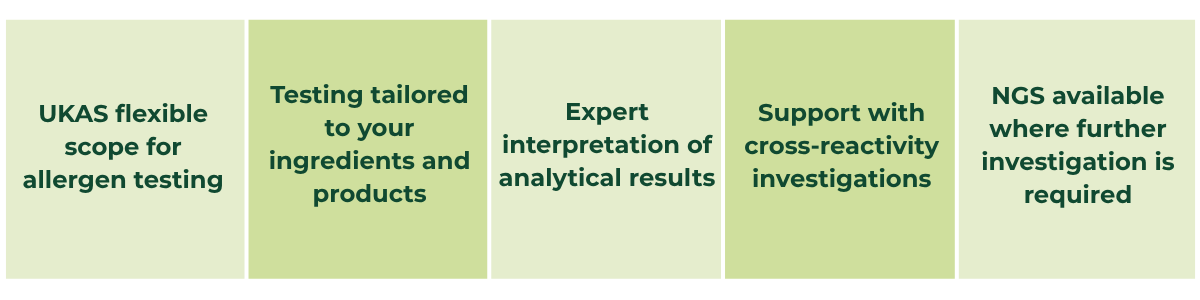
Allergens have long been one of the most important food safety concerns for consumers, hospitality businesses and food manufacturers. The introduction of Natasha's Law further highlighted the importance of accurate allergen management and clear food labelling.
Testing alone is not always enough. Understanding ingredients, manufacturing processes, sourcing risks and the limitations of different analytical techniques is essential when developing an effective allergen control programme.
Considering where raw materials are produced and processed is an important part of allergen risk assessment. Unexpected contamination can occur long before ingredients arrive at your manufacturing site.
|
Testing is an important tool for allergen management, but off-the-shelf testing without understanding the sample, ingredients and potential cross-reactivity may lead to misleading conclusions.
Minor exposure to allergens such as peanut can be life-threatening for sensitive consumers. Selecting appropriate test methods and understanding the limitations of each technique is therefore critical.
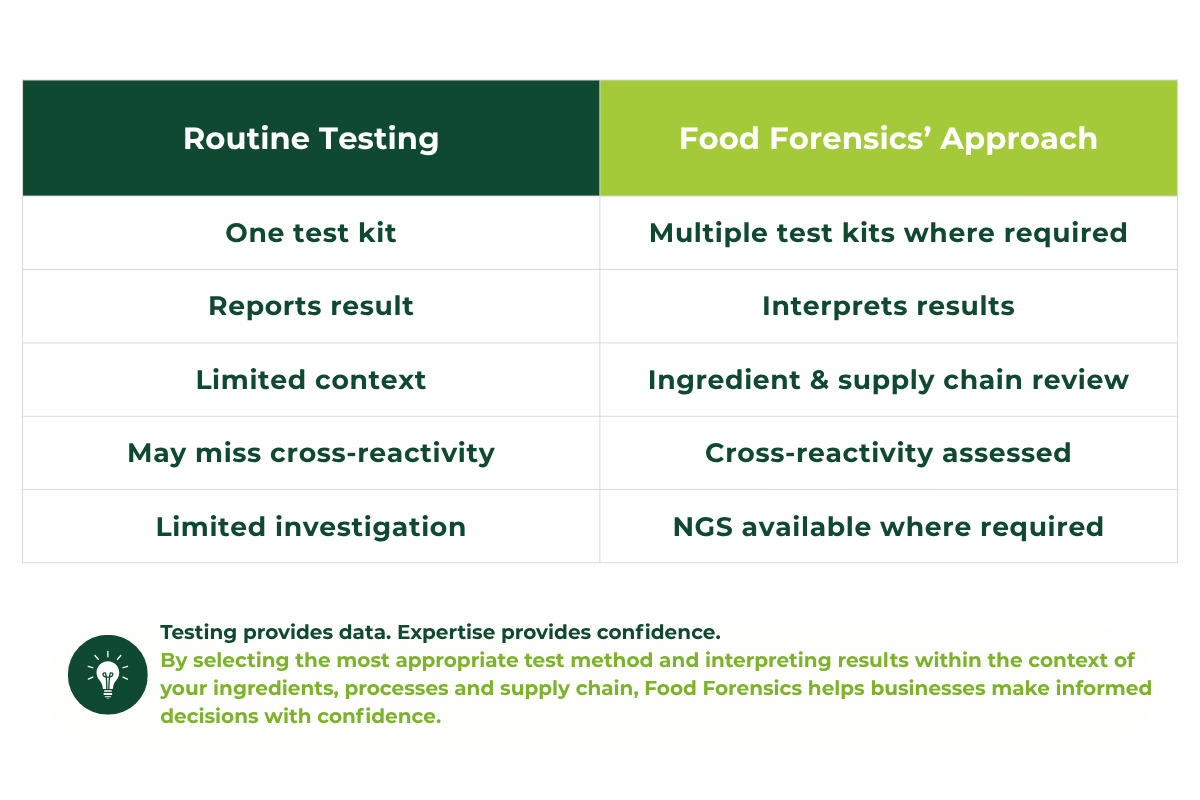
At Food Forensics, test kits are selected based on the declared ingredients within the product. Where an initial positive result is obtained, we immediately repeat the analysis using a different analytical kit with an alternative cross-reactivity profile.
If both tests return positive results, we report a positive finding. Where results differ, further investigation may be recommended. This risk-based approach helps provide greater confidence in analytical results and supports informed technical decision-making.
|
Allergen testing is rarely a one-size-fits-all exercise. Our technical specialists can help determine the most appropriate testing strategy based on your ingredients, manufacturing processes and supply chain risks.
Whether you're investigating a positive result, developing an allergen monitoring programme or assessing supplier risk, we're here to help.
Speak to a Technical AdvisorUKAS flexible scope for allergen testing Technical interpretation of results Cross-reactivity investigations Risk-based testing strategies
|
