What is Vegan Verification?
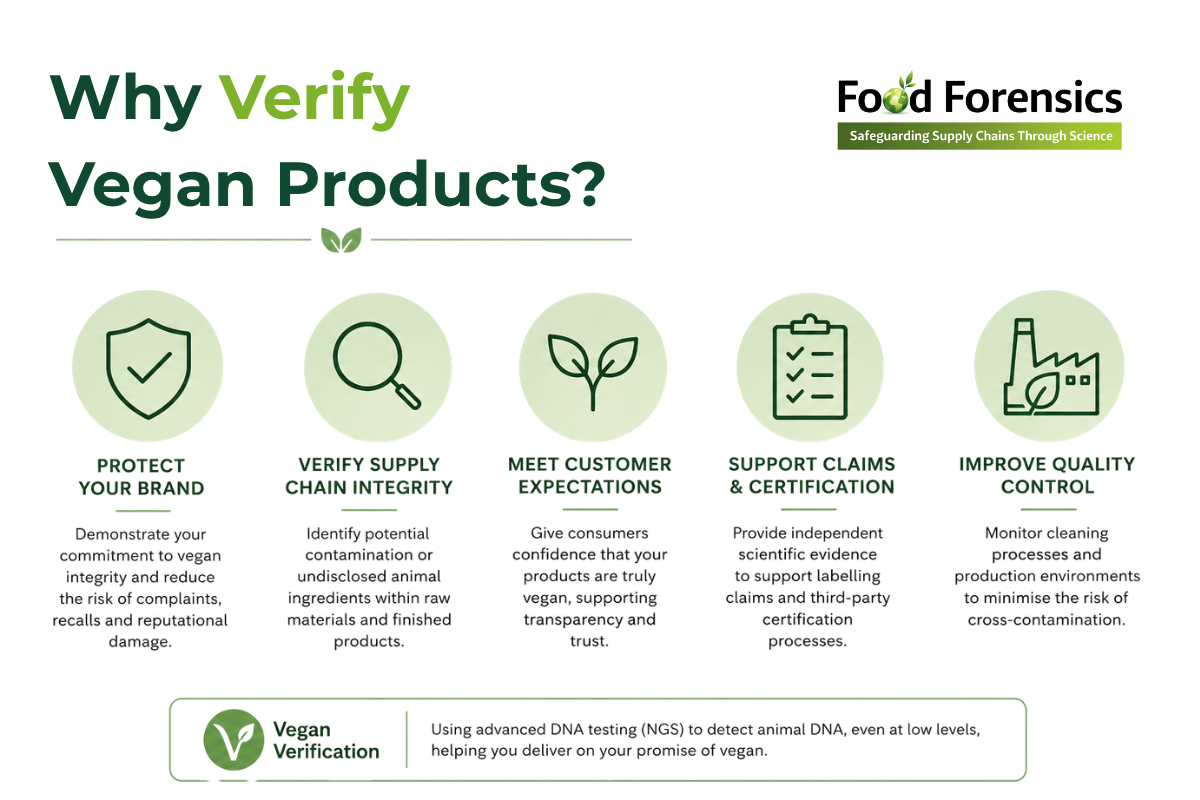
Consumers increasingly expect products labelled as vegan to meet the highest standards of transparency and integrity. Vegan Verification helps manufacturers, retailers and food service businesses demonstrate due diligence by investigating whether detectable animal DNA is present within a food sample.
Food Forensics uses Next Generation Sequencing (NGS), a powerful non-targeted DNA testing technique capable of screening for thousands of animal species from a single sample. This enables broad investigations where unexpected animal material may be present.
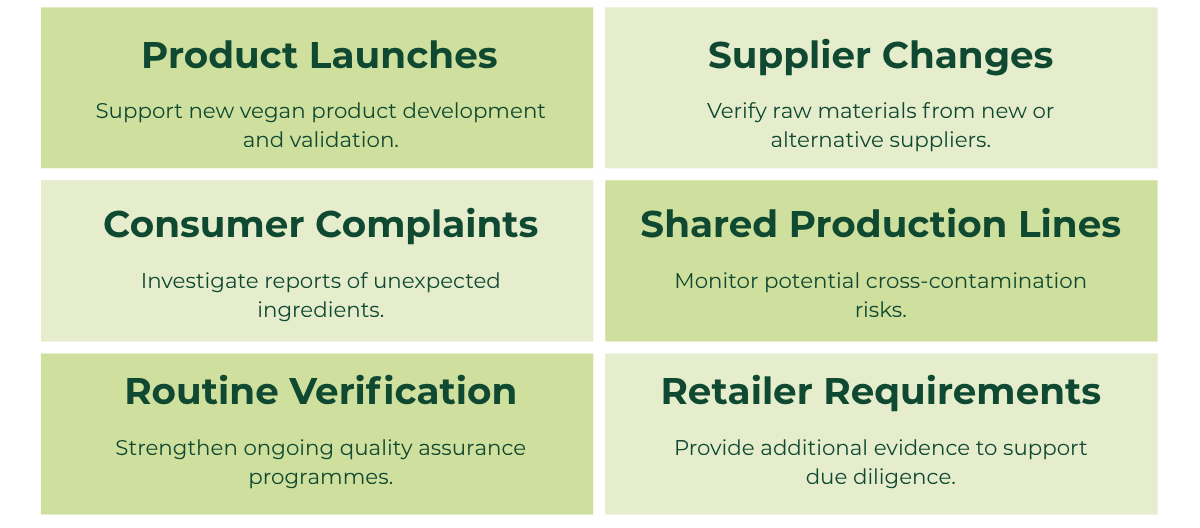
When Should You Consider Vegan Verification?
Independent laboratory testing can support a wide range of food integrity challenges, from launching new products to investigating unexpected contamination.
Supporting The Vegan Society's Vegan Trademark
Food Forensics is proud to work with The Vegan Society to support its Vegan Trademark verification process for food, drink and animal feed products.
Using Next Generation Sequencing (NGS), our laboratory can analyse samples for the presence of detectable animal DNA, providing independent scientific evidence to support vegan verification. This testing can be particularly valuable where supply chain information is incomplete or where additional reassurance is required.
Laboratory testing forms part of a wider verification process and complements, rather than replaces, the robust assessment carried out by The Vegan Society. Vegan Trademark applicants and existing Trademark Holders are still required to provide comprehensive technical information, including ingredient specifications, supplier documentation, manufacturing processes and cleaning procedures.
NGS testing can be used to support applications by helping demonstrate that ingredients, finished products and manufacturing processes are consistent with vegan expectations. It can also assist investigations into potential cross-contamination and provide additional confidence in production controls.
How Food Forensics Supports Vegan Trademark Applicants
- Independent laboratory testing using Next Generation Sequencing (NGS)
- Testing of ingredients and finished products for detectable animal DNA
- Support for Vegan Trademark applications and ongoing verification
- Investigation of potential cross-contamination events
- Additional evidence to complement supplier approval and quality management systems
- Technical advice from food authenticity specialists
|
Our role is to provide independent scientific analysis that supports businesses throughout the verification process. By combining advanced DNA testing with practical food authenticity expertise, we help manufacturers, retailers and brand owners strengthen confidence in vegan label claims and supply chain integrity.
Why Businesses Trust Food Forensics
UKAS Accredited
Accredited laboratory providing trusted analytical testing.
|
Food Integrity Specialists
Experts in food authenticity, species identification and food fraud investigations.
|
Technical Advice
Our scientists help determine the most appropriate testing strategy for your products.
|
Vegan Verification FAQs
We've answered some of the questions we're most frequently asked about Vegan Verification, Next Generation Sequencing (NGS) and how laboratory testing supports vegan claims.
Can you certify that my product is vegan?
No.
Certification of vegan foods by a recognised body considers manufacturing processes, supply chains, quality practices and the ingredients used. Where a product meets the required standards, certification may be granted.
Laboratory testing is different. Food Forensics uses Next Generation Sequencing (NGS) to analyse a submitted sample for the presence or absence of detectable animal DNA. The analytical profile is compared with that established for validated vegan products to provide independent scientific evidence.
NGS testing can therefore support and monitor the certification process but does not replace certification itself.
|
Can you detect traces of animal DNA?
Yes.
NGS can detect animal DNA present in a sample above its validated reporting threshold. It is a highly sensitive, non-targeted DNA analysis technique capable of identifying trace amounts of animal DNA that may be present through contamination or processing.
Species detected above the validated reporting threshold (>0.5% of identified reads) are reported, providing valuable evidence to support vegan verification and food authenticity investigations.
|
Is Vegan Verification suitable for processed foods?
Yes, in most cases.
NGS is suitable for many processed foods because DNA often survives common manufacturing processes. However, highly refined ingredients may contain little or no detectable DNA, which can limit the ability of the test to identify species.
Where DNA is absent, highly degraded or inhibited, the result may be inconclusive or no result may be obtained. Our technical team can advise on sample suitability before testing.
|
Does Vegan Verification replace supplier approval?
No.
Vegan Verification using NGS provides independent laboratory evidence of whether detectable animal DNA is present within the submitted sample.
It complements, but does not replace, supplier approval, ingredient verification, risk assessments or quality management systems. Laboratory testing should form part of a wider food integrity programme.
|
Can Food Forensics help investigate contamination?
Yes.
NGS is a powerful investigative tool capable of identifying unexpected animal species within a sample. Because the method is non-targeted, it can detect a broad range of species without requiring a predefined target list.
This makes NGS particularly valuable when investigating contamination, adulteration, species substitution, mislabelling or unexpected findings within vegan and plant-based products.
|
Speak to a Technical Advisor
Whether you're launching a new vegan product, investigating potential contamination or strengthening your supplier assurance programme, our technical specialists can help you determine the most appropriate testing strategy.
Contact Our Team
|
